Korean Skincare Explained: What It Is and How It Differs From Western Beauty
If you have ever stood in the skincare aisle wondering why one shelf promises a ten-step ritual while the next promises a single miracle cream, you have already felt the split at the heart of modern beauty. Korean skincare is not just a trend or a set of pretty pastel bottles — it is a whole philosophy built on gentle, consistent hydration and prevention, rather than on strong treatments that fix problems after they appear. This guide breaks down exactly what Korean skincare is, how it differs from Western beauty, and how to build a routine that fits your life.
What Is Korean Skincare, Really?
At its simplest, Korean skincare is the skincare culture that grew out of South Korea, where caring for skin is treated as a daily habit — more like brushing your teeth than like a special occasion. The focus is on keeping the skin barrier healthy, hydrated, and calm, so breakouts, dryness, and dullness have less chance to take hold.
That idea is not new in Korea — ingredients like rice water, green tea, ginseng, and fermented extracts have been part of home beauty rituals for generations.
Western beauty, by contrast, grew up around dermatology clinics and pharmacy shelves. Its heroes are potent, targeted actives: retinol for fine lines, vitamin C for brightness, salicylic acid for breakouts. The Western approach tends to ask, “What problem are we solving?” The Korean approach tends to ask, “How do we keep skin healthy so fewer problems show up?” Neither question is wrong — they simply lead to very different routines, textures, and ingredient lists.
The Philosophy: Prevention vs. Correction
The biggest difference between Korean skincare and Western beauty is not the number of steps or the packaging. It is the philosophy underneath.
Western skincare is largely corrective. You notice a wrinkle, a dark spot, or a breakout, and you reach for a product designed to fix it. The formulas are often strong, the results can be fast, and the trade-off is a higher risk of irritation, peeling, or dryness.
Korean skincare is largely preventive. The goal is to keep skin hydrated, calm, and resilient every single day, so it ages more slowly and reacts less. Products are usually gentler, lower in concentration, and designed to be layered. You may not see a dramatic change in a week, but over months the skin tends to look plumper, smoother, and more even.
Think of it this way: Western beauty is like calling a plumber when a pipe bursts. Korean skincare is like checking the pipes every month so they never burst. Most people do best with a little of both.
The 10-Step Myth — What Real Routines Actually Look Like
Ask anyone what Korean skincare is and they will probably mention the famous 10-step routine: oil cleanser, foam cleanser, exfoliant, toner, essence, serum, sheet mask, eye cream, moisturizer, sunscreen. It sounds exhausting — and, for most people in Korea, it is not real life.
A 2015 survey by Korea’s Ministry of Food and Drug Safety, covering around 1,800 adults, found that most Korean women use about five to six products a day, not ten. The ten-step routine was always a maximalist version, popularized by beauty bloggers and brands, not a daily requirement.
In practice, a real Korean routine is usually four to seven steps, and it flexes with the day. A busy morning might be cleanser, toner, moisturizer, and sunscreen; an evening routine might add an essence and a serum. Sheet masks are a once-or-twice-a-week treat, not a daily duty.
The lesson: you do not need ten products to do Korean skincare — you need the right few, used consistently, in the right order. Buying all of it at once is the fastest way to irritate your skin and waste your money.
Double Cleansing: The Step That Started It All
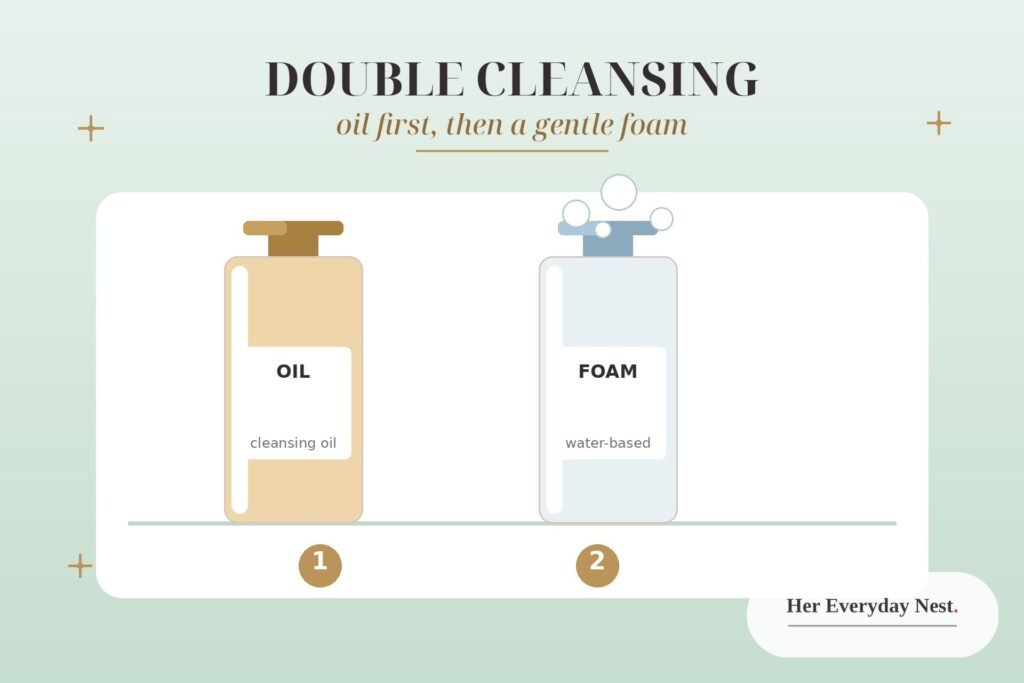
If there is one step that defines Korean skincare, it is double cleansing — washing your face twice, with two different kinds of cleanser, every evening.
Step one is an oil-based cleanser: a cleansing oil or balm that melts away sunscreen, makeup, and sebum. Oil dissolves oil, so this step removes the things water alone cannot. Step two is a gentle water-based cleanser — a low-pH foam or gel — that washes away sweat, dirt, and whatever residue the oil left behind.
Why two steps? Because a single harsh cleanser strong enough to remove sunscreen and makeup in one pass usually strips the skin too. Two gentle steps clean just as well while leaving the skin barrier intact.
A few practical notes: double cleansing is mainly an evening habit. In the morning, a single gentle wash — or even just lukewarm water if your skin is very dry — is usually enough.
Layering: Thinnest to Thickest
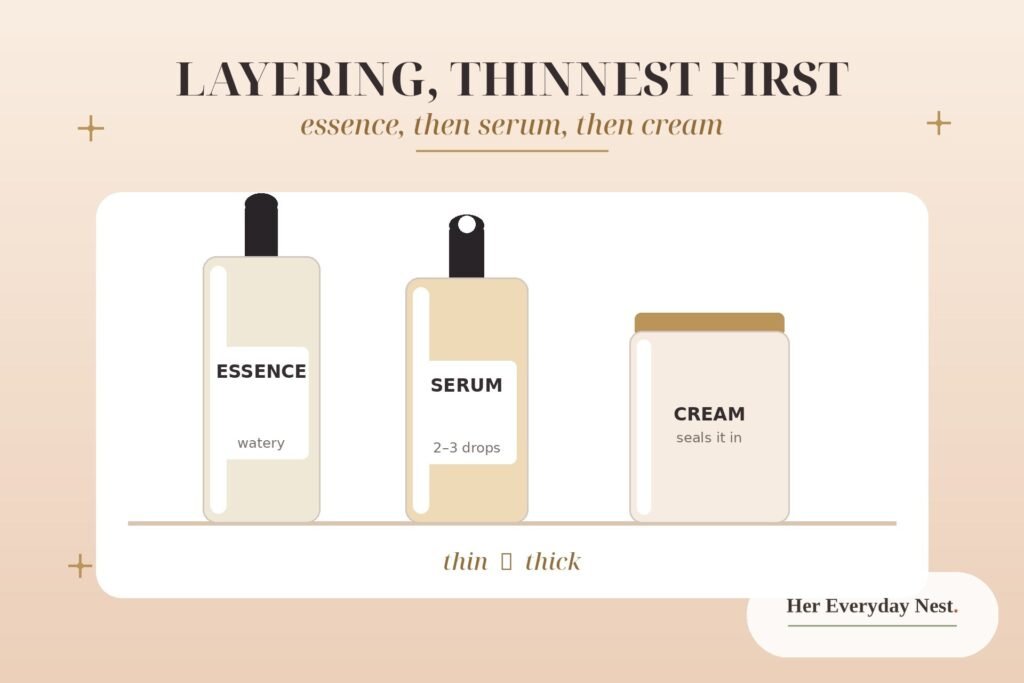
The second signature idea in Korean skincare is layering — applying several lightweight products in order, from the thinnest texture to the thickest, so each one absorbs before the next goes on.
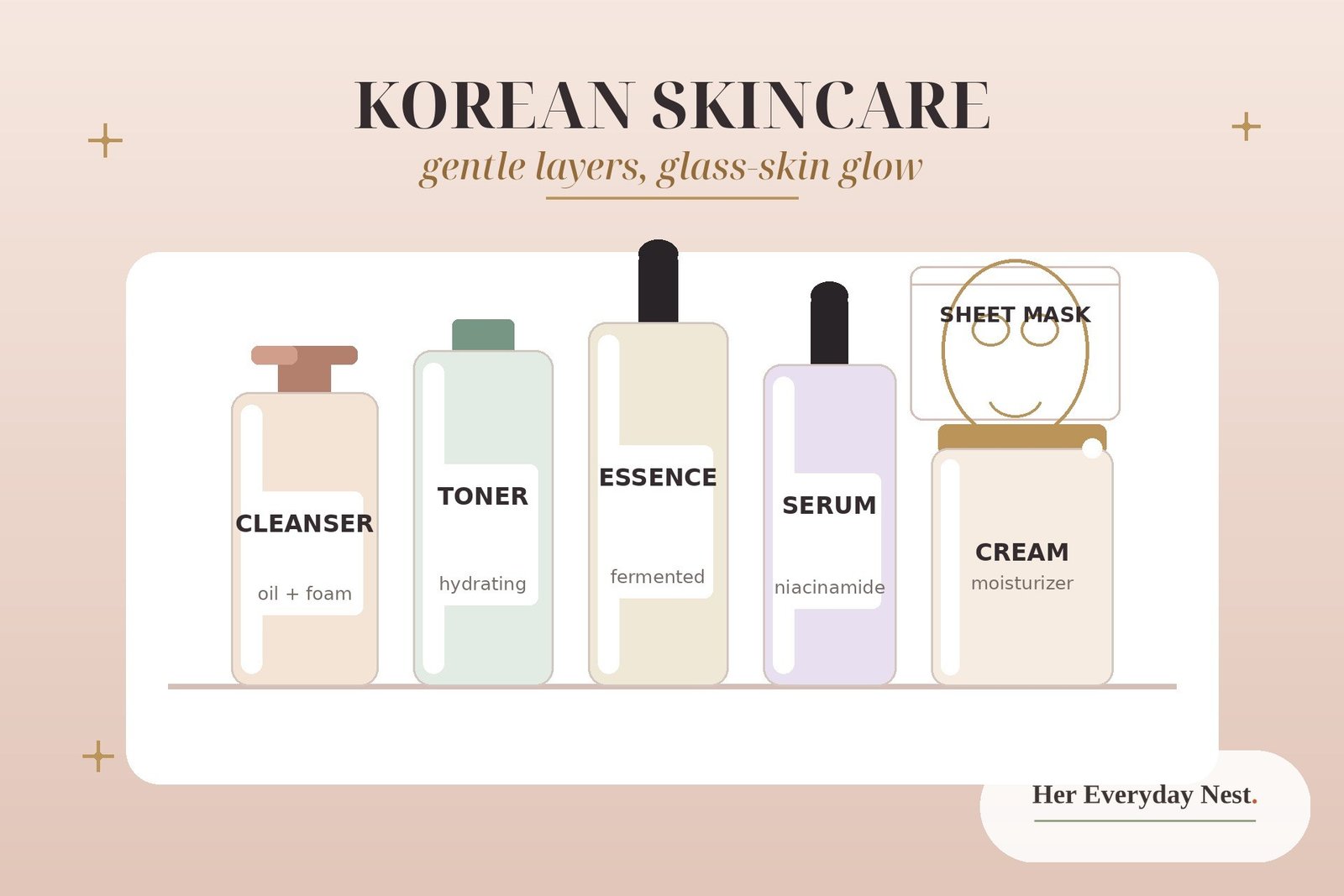
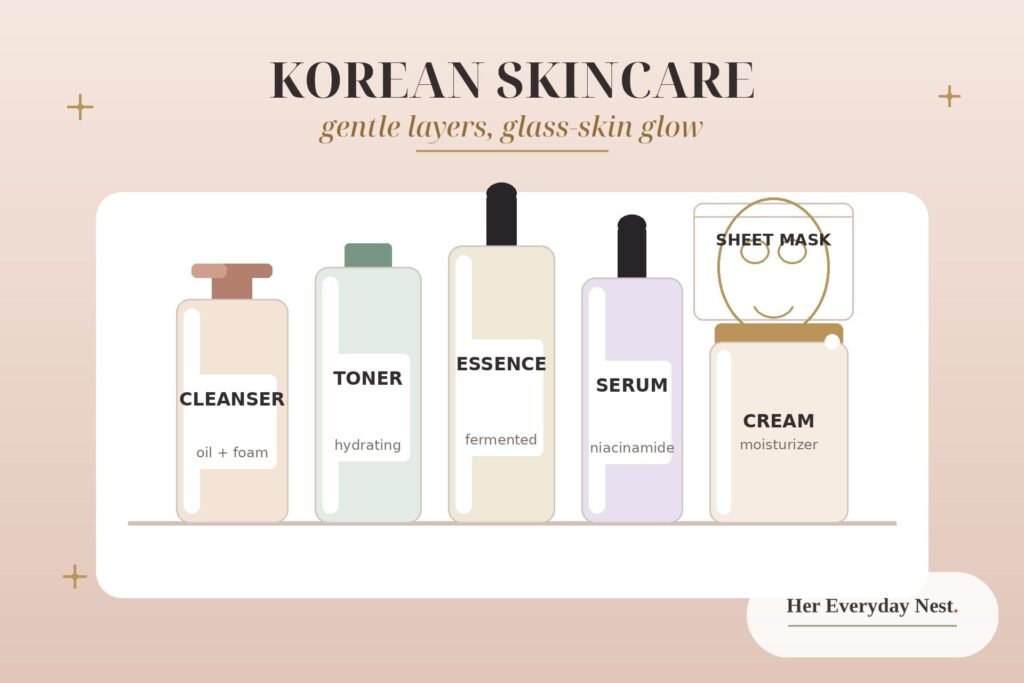
The usual order is: cleanser, toner, essence, serum or ampoule, eye cream, moisturizer, and sunscreen in the morning. Toners in Korean skincare are not the harsh, astringent toners many Western shoppers remember from the 1990s. They are hydrating, watery liquids that prep the skin and add a first layer of moisture.
The step that confuses newcomers most is the essence. An essence is a lightweight, watery liquid — thinner than a serum, more concentrated than a toner — designed to flood the skin with hydration and help the products that follow absorb better. Do you need one? Honestly, no. An essence is a nice-to-have, not a must-have. If your skin is dehydrated or you love the ritual of layering, it earns its place. If you want a short routine, a good hydrating toner does much of the same job.
Application matters too. Korean skincare favors patting products into the skin with your palms or fingertips, rather than rubbing them in. Patting is gentler, it presses the product in instead of dragging across it, and it means less tugging around the delicate eye area.
One more detail worth knowing: Korean cleansers tend to sit at a skin-friendly pH of around 4.5 to 6.5, close to the skin’s natural pH. Many traditional Western cleansers measure closer to 7 to 9, which can leave skin feeling tight and squeaky — a sign the barrier has been stripped. A healthy skin barrier keeps moisture in and irritants out, which is why this small choice matters so much over time.
Signature K-Beauty Ingredients vs. Western Staples
Ingredients are where the two traditions look most different on a label — and where they complement each other best.
Korean skincare leans on soothing, hydrating, and fermented ingredients. Snail mucin, famous for hydration and repair support, is the one everyone asks about first — and yes, it is exactly what it sounds like, collected without harming the snails. Centella asiatica, often called cica, is a calming plant extract used for redness and sensitivity. Fermented ingredients like galactomyces are prized for brightening and texture. Rice water, propolis, ginseng, and niacinamide round out the classic Korean pantry: gentle, hydrating, and focused on glow rather than on aggressive renewal.
Western skincare leans on proven, potent actives. Retinol and its gentler cousins speed up cell turnover and smooth fine lines. Vitamin C brightens and supports collagen. AHAs and BHAs exfoliate — glycolic acid on the surface, salicylic acid inside the pores. Peptides signal the skin to repair itself. These ingredients have decades of clinical research behind them, and for specific concerns like deep wrinkles or stubborn acne, they are often the most effective tools available.
The smart move is not to choose a side. It is to build a gentle Korean-style base — cleanser, hydrating toner, moisturizer, sunscreen — and add one Western active at a time for the concern you actually have. That way you get the research-backed power of retinol or vitamin C without sacrificing the calm, hydrated base that keeps irritation away.
Korean Skincare vs. Western Beauty: Side-by-Side
| Korean Skincare | Western Beauty | |
|---|---|---|
| Philosophy | Prevention: keep skin healthy so problems appear less | Correction: target and fix visible concerns |
| Routine length | Usually 4–7 steps, flexible by day | Usually 3–5 steps, focused and minimal |
| Key ingredients | Snail mucin, centella (cica), fermented extracts, rice water, propolis, ginseng, niacinamide | Retinol, vitamin C, AHA/BHA, peptides, salicylic acid |
| Textures | Lightweight, watery layers: essences, emulsions, gel creams | Richer creams, potent serums, occlusive moisturizers |
| Cleanser pH | Usually 4.5–6.5, close to skin’s natural pH | Often 7–9 in traditional formulas; low-pH options growing |
| Cost | Often very affordable; drugstore-level pricing for many staples | Wide range; prestige actives can be expensive |
| Best for | Dehydration, dullness, sensitivity, maintaining healthy skin | Fine lines, dark spots, acne, targeted concerns |
| Ideal finish | Glass skin — dewy, translucent, hydrated glow | Matte or satin finish; “clean” or airbrushed look |
Textures, pH, and the Glass-Skin Ideal
If Western beauty’s ideal finish is often matte or airbrushed, Korean skincare’s is glass skin — skin so hydrated and smooth that it reflects light like glass. The Korean word often used is chok-chok, meaning moist and dewy from within.
Glass skin is not about shine or oiliness. It is about deep hydration: skin that is plump with water, with a smooth surface that catches light evenly. That is why the routine is built on layers of watery products rather than on one heavy cream.
This is also why the dewy base matters beyond skincare. A hydrated, glowing base is what makes a clean girl makeup look actually work — the makeup sits on healthy skin instead of fighting dry patches. And on evenings when you want more drama, that same smooth canvas is the perfect starting point for a soft glam smoke makeup look, because the glow underneath keeps the smoky eye from looking harsh.
One caution: glass skin is a goal, not a deadline. Chasing it with too many exfoliants or too many layers at once is the most common beginner mistake. If your skin starts to sting or flake after adding new products, that is not “purging” — it is your barrier asking you to slow down.
A Realistic Beginner Routine: 4 Steps
Forget ten steps. If you are new to Korean skincare, start with four products and use them for at least four weeks before adding anything else.
Step 1 — Cleanse. In the evening, double cleanse: an oil cleanser followed by a gentle low-pH foam or gel. In the morning, one gentle wash is enough.
Step 2 — Hydrate. A hydrating toner, patted in with your palms while skin is still slightly damp.
Step 3 — Moisturize. A lightweight gel cream in warm weather or a richer cream in winter, chosen for your skin type. If your skin gets tight and flaky when temperatures drop, a little winter skincare prep — like switching to a creamier moisturizer before the cold sets in — goes a long way.
Step 4 — Protect. Sunscreen every morning, SPF 30 or higher, even on cloudy days. This is the one step Korean and Western dermatologists agree on completely, and it does more for long-term skin health than any serum. The American Academy of Dermatology’s basic skin care steps are a good place to check the fundamentals before you add anything fancy.
After a month, if your skin is calm and happy, add one new product — an essence for extra hydration, or a serum for a specific concern. Add one at a time, wait two weeks, and watch how your skin responds.
Who Should (and Shouldn’t) Go Full K-Beauty
Korean skincare suits most skin types, but it is not a universal prescription.
It tends to work beautifully for dry or dehydrated skin, because the whole system is built around adding water back in layers. It is often a relief for sensitive skin, because the formulas are usually gentle and low in harsh actives.
It is less of a clear win for severe or cystic acne, where prescription-strength treatments and a dermatologist’s guidance matter more than any over-the-counter routine. It is also worth approaching carefully if your skin is extremely reactive: even gentle products can irritate when you introduce five new ones at once.
How to Mix Korean and Western Products Safely
Mixing the two traditions is where the real magic happens — and where most mistakes happen too. A few rules keep it safe.
First, keep the base Korean and add Western actives one at a time. A gentle cleanser, hydrating toner, and moisturizer give strong actives a calm home, which means less irritation from retinol or vitamin C.
Second, never layer two strong exfoliants or two strong actives on the same night. Retinol plus a strong AHA, or vitamin C plus a BHA, is a fast route to a damaged barrier. Alternate them on different nights instead.
Third, watch for duplicates. Many Korean essences and serums already contain niacinamide, and many Western products do too. Using three niacinamide products at once is not better than using one.
Fourth, introduce one new product every two weeks, and patch-test on your jawline or behind your ear first.
Finally, sunscreen is non-negotiable whenever you use retinol, vitamin C, or any exfoliating acid. Those actives make skin more sun-sensitive, and skipping sunscreen undoes their benefits.
How Much Does It Cost?
One of the most pleasant surprises about Korean skincare is the price. Many of the most-loved Korean staples cost about the same as a drugstore moisturizer — often less than a single prestige Western serum — because the system is built on simple, well-made basics rather than on one expensive hero product.
That said, costs add up when you buy ten products at once — which is exactly why the beginner routine above starts with four. A realistic starter set (cleanser, toner, moisturizer, sunscreen) can cost less than one high-end Western serum and last two to three months. You do not need a big budget — you need consistency.
Korean skincare is not a ten-step obligation or a shelf full of pastel bottles. It is a gentler way of thinking about skin: prevent more, correct less, hydrate in light layers, and protect the barrier that does most of the work for you. Borrow the philosophy, keep the Western actives that actually solve your problems, and build a routine you can stick with for years. That is the whole secret — and it fits in four steps.
Is Korean skincare actually better than Western skincare?
Neither one is better across the board — they are built for different jobs. Korean skincare is stronger on gentle hydration, prevention, and keeping the skin barrier healthy, while Western skincare is stronger on potent, research-backed actives like retinol and vitamin C for specific concerns. Most dermatologists and skincare experts say the best routine borrows from both: a gentle Korean-style base with one or two targeted Western treatments added in.
How many steps does a Korean skincare routine really have?
The famous 10-step routine is mostly a myth. A 2015 survey by Korea’s Ministry of Food and Drug Safety found that most Korean adults use about five to six products a day, and many use fewer. A realistic routine is four to seven steps: cleanser, toner, essence or serum, moisturizer, and sunscreen in the morning. Sheet masks and exfoliants are weekly extras, not daily requirements.
What is an essence and do I need one?
An essence is a lightweight, watery liquid that sits between toner and serum in a Korean routine. It is designed to add a layer of hydration and help the products that follow absorb better. You do not need one — a good hydrating toner covers much of the same ground. An essence is worth trying if your skin feels dehydrated even after toner and moisturizer, or if you enjoy the layering ritual.
Can I mix Korean and Western skincare products?
Yes, and most people get the best results from mixing the two. The safest approach is to keep a gentle Korean-style base — cleanser, hydrating toner, moisturizer, sunscreen — and add one Western active at a time, such as retinol or vitamin C. Avoid layering two strong actives on the same night, watch for duplicated ingredients like niacinamide, and always wear sunscreen when you use exfoliating acids or retinol.
How long does it take to see results from Korean skincare?
Hydration and glow usually improve within two to four weeks of consistent use, because the layering approach restores moisture quickly. Changes in texture, dullness, or fine lines take longer — typically six to twelve weeks, since skin renews itself on roughly a monthly cycle. If a product has not shown any benefit after three months of steady use, it is probably not the right one for your skin.

Emily Carter is the founder and editor of Her Everyday Nest. After nine years of renting in five apartments across three cities, she's learned how to make any rental feel like home.