
Ninja DualBrew vs Keurig K-Duo: Which Dual Brewer Wins?
If your kitchen needs one machine that can make a quick single cup and a full pot, this ninja dualbrew vs keurig k duo comparison settles the argument between the two best-known dual brewers. The Ninja DualBrew brews both fresh grounds and K-Cup pods, while the Keurig K-Duo Plus pairs K-Cup pods with a ground-coffee carafe — the same promise, delivered in two very different ways.
How this comparison was put together: every claim below is checked against the manufacturers’ published specifications, verified buyer reviews, and independent expert testing, including Consumer Reports lab testing of both machines. No invented test results, no ownership story — just what each machine does, where it wins, and where it falls short, so you can buy the right one the first time.
One important note: most comparisons online use the standard K-Duo or the newer K-Duo Hot & Iced, not the K-Duo Plus. This comparison is scoped to the two exact models linked here — the Ninja DualBrew Pro (CFP307) and the Keurig K-Duo Plus (model 5200) — because the Plus is a different machine, with a thermal carafe, a slimmer body, and its own quirks. The short version: the Ninja is the more flexible machine and wins for most households, while the Keurig is the simpler, slimmer pick for pod-first households.
Quick Verdict
Overall take: The Ninja DualBrew Pro wins this ninja dualbrew vs keurig k duo matchup for most households — it brews single cups from grounds as well as pods, adds a frother, iced-coffee styles, and a hot-water spout the Keurig cannot match. Best for: mixed households, latte and iced-coffee drinkers, and anyone who wants one machine to replace three. Skip the Ninja if: you only ever brew pods, your cabinets are low, or you want the simplest possible machine — then the Keurig K-Duo Plus is the better buy.
At a Glance: Ninja DualBrew vs Keurig K Duo
Feature | Ninja DualBrew Pro (CFP307) | Keurig K-Duo Plus (5200) |
|---|---|---|
Brews grounds + pods | Yes — both, in one central brewer | Yes — pods for single cups, grounds for the carafe |
Single cup from grounds | Yes, built in (9 grounds sizes) | No — pods only; My K-Cup reusable filter is the workaround |
Brew sizes | 13 total (9 grounds + 4 pod, 6–12 oz) | 8 total (4 single 6–12 oz + 4 carafe 6–12 cups) |
Brew styles | Classic, Rich, Over Ice, Specialty (4 oz concentrate) | Strong Brew (single + carafe); no iced or specialty style |
Carafe | 12-cup thermal carafe (CFP307) | 12-cup stainless thermal carafe, warm up to 2 hours |
Water reservoir | 60 oz, removable, side or back | 60 oz, removable, left, right, or rear |
Built-in frother | Yes, fold-away | No |
Hot-water dispenser | Yes, independent spout | No |
Programmable auto brew | Up to 24 hours | Up to 24 hours (carafe only) |
Width | Bulkier footprint — measure first | 7.68 in wide (reservoir rear) |
Check it out |
Ninja DualBrew Pro: The Flexible All-Rounder
The Ninja DualBrew Pro is the do-everything machine in this ninja dualbrew vs keurig k duo comparison, and it earns that label honestly. One central brewer handles grounds and K-Cup pods, with 13 sizes from a small cup to a full 12-cup carafe, and four brew styles — Classic, Rich, Over Ice, and Specialty — that apply to the carafe as well as single cups. The built-in fold-away frother turns the 4 oz Specialty brew into a convincing homemade latte, and the independent hot-water spout makes tea, cocoa, and oatmeal without running water through the coffee line. The 60 oz reservoir slides to the side or back to fit tight counters, and a permanent filter comes in the box.
The trade-offs are size and honesty about espresso. This is a substantial machine — small kitchens should measure first. The Specialty brew is a rich coffee concentrate, not pressure-brewed espresso, so espresso lovers should look elsewhere. The pod adapter is bulky with no onboard storage spot, and Consumer Reports found cup-to-cup temperature consistency can vary. But for a household that mixes pods, pots, lattes, and iced coffee, no other machine here covers all four.
Keurig K-Duo Plus: The Slim Pod-and-Pot Specialist
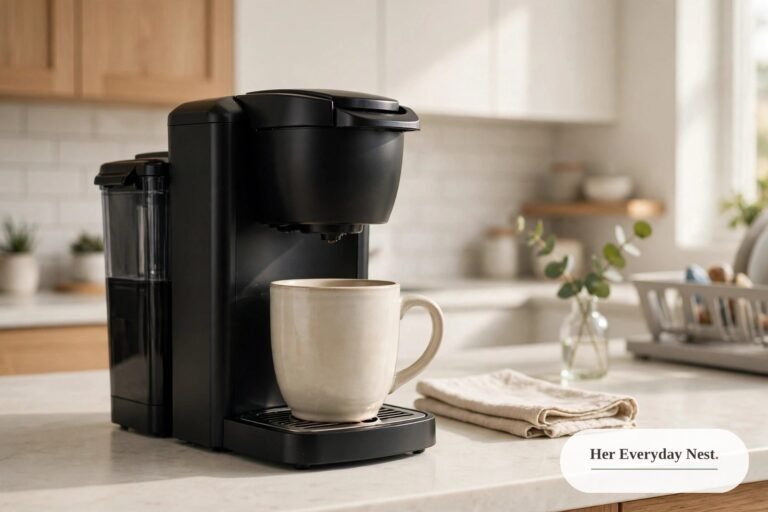
The Keurig K-Duo Plus takes the opposite approach: instead of doing everything, it does two things simply. One side brews K-Cup pods in 6, 8, 10, or 12 oz; the other brews a 6- to 12-cup carafe from ground coffee, sharing one 60 oz reservoir that can sit on the left, right, or rear. With the reservoir at the back it is just 7.68 inches wide, and the 12-cup stainless thermal carafe keeps coffee warm for up to 2 hours without a hot plate turning it bitter. Strong Brew works on both sides, programmable carafe auto brew runs up to 24 hours ahead, and Pause & Pour lets you grab a first cup mid-brew.
Its limits define who should buy it. The single-serve side runs on pods only — grounds need the My K-Cup reusable filter — and there is no iced setting, no frother, and no temperature control. Programming applies to the carafe only, and the thermal carafe has no reheat plate once the two-hour window passes. Owners also report descale lights that stay on and slow water flow when maintenance slips. Within those limits, it is the easiest dual brewer to live with — and the only one here that disappears into a narrow counter.
Ninja DualBrew vs Keurig K Duo: Single Cups — Grounds or Pods?
This is the single biggest difference in this ninja dualbrew vs keurig k duo comparison, and it decides the winner for a lot of buyers. The Ninja brews a single cup straight from your own ground coffee, in nine sizes, as well as from K-Cup pods through its adapter. The Keurig’s single-serve side brews pods only. That matters twice: cost and choice. Grounds cost meaningfully less per cup than pods, and grounds let you brew any bag, any roast, any grind.

The Keurig does have a workaround: the My K-Cup Universal Reusable Coffee Filter lets the single-serve side brew your own grounds. It works and cuts pod cost, but it is an extra part to fill, empty, and rinse every cup — not the same as the Ninja’s built-in grounds brewing. If your mornings are mostly single cups and you already buy ground coffee, the Ninja’s grounds single-cup brewing alone justifies its place on the counter. If your mornings are mostly pods and the carafe only comes out on weekends, the Keurig’s pod-first design is simpler and you will never miss the feature.
Carafe Brewing and Brew Styles
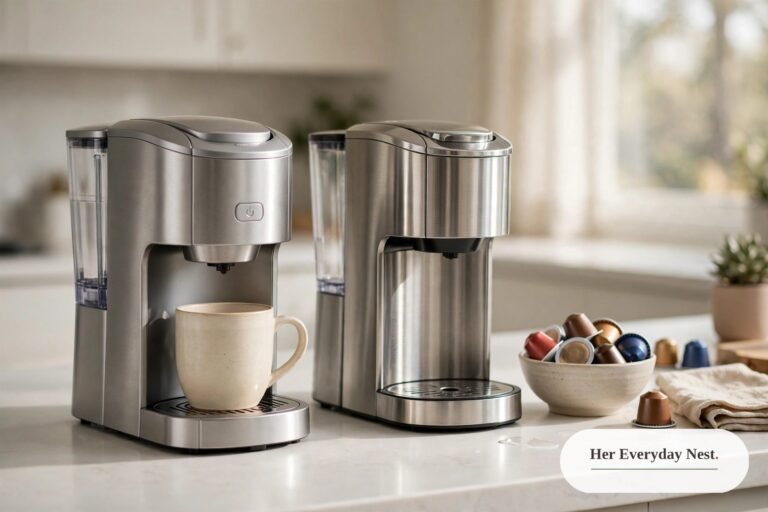
Both machines brew a 12-cup carafe from grounds, and both keep it warm in a thermal carafe rather than on a hot plate — the Ninja CFP307’s thermal carafe and the Keurig’s stainless thermal carafe rated for up to 2 hours. Where they split is what the carafe can do. On the Ninja, all four brew styles work for the carafe: Classic for everyday, Rich for a stronger pot, Over Ice for a full pitcher of iced coffee, and Specialty for a concentrated base. On the Keurig, the carafe gets Strong Brew and nothing else — no iced setting, no specialty concentrate, no temperature adjustment.

Both machines offer a 24-hour delay brew, but with a catch on the Keurig side: programming applies to the carafe only, never to a single-serve cup. Pause & Pour on the Keurig (20 seconds mid-brew) is a genuinely useful touch the Ninja does not advertise the same way, though the Ninja’s carafe brewing is the more flexible of the two by a clear margin. If your household drinks mostly pots, the Ninja’s carafe styles are the reason to pick it; if the pot is a weekend-only job, the Keurig’s simpler carafe is plenty.
Lattes, Iced Coffee, and Hot Water
This section is short because the gap is wide. The Ninja DualBrew Pro has a built-in fold-away frother for hot or cold foam, an Over Ice style that brews concentrated enough to stand up to ice, and a Specialty brew designed as a latte base. That combination makes lattes, cappuccinos, macchiatos, and iced lattes from one machine, with no extra appliance. The Keurig K-Duo Plus has none of it: no frother, no iced-coffee setting, no specialty concentrate. Iced coffee from the Keurig means brewing hot coffee and pouring it over ice yourself, which waters it down.

The Ninja’s independent hot-water dispenser is the quieter win: tea, cocoa, and oatmeal come from a separate spout, so tea never carries a hint of yesterday’s coffee. The Keurig has no hot-water function at all, so non-coffee drinkers still need a kettle. If lattes, iced coffee, or tea matter in your house, this section alone ends the debate in the Ninja’s favor; if none of them do, the comparison comes back to simplicity and size.
Footprint, Height, and Kitchen Fit
Here the Keurig fights back in this ninja dualbrew vs keurig k duo footprint check. The K-Duo Plus is 14.19 inches tall with the handle closed and just 7.68 inches wide with the reservoir at the rear — a slim tower that fits counters where a dual brewer normally would not. The Ninja is the bulkier machine: it has to be, to hold a carafe brewer, a pod brewer, a frother, and a 60 oz tank in one body. Both reservoirs hold 60 oz and both can be repositioned, so neither wins on water capacity; the Keurig wins on width, the Ninja loses on footprint, and small kitchens should measure both before ordering.
The catch on the Keurig is height, not width: with the handle open for pod loading it reaches 17.5 inches, so low-hanging cabinets can block it even when the closed height fits. Side-mounting the reservoir solves the reach problem but widens the machine to 8.2 inches. Measure your cabinet clearance and your reach, not just the width — the spec that catches buyers out on both machines is a dimension they did not check.
Temperature, Taste, and Cost Per Cup
Taste is where lab testing separates these two most clearly in this ninja dualbrew vs keurig k duo comparison. Consumer Reports’ testing found the Ninja’s drip brewing reached close to the recommended 195°F-plus range for several minutes, the standard for proper extraction, with an especially quick first cup — and buyers consistently describe the coffee as rich and full, not thin, across both grounds and pods. The same lab testing found the Keurig’s drip side fell short of the 195°F guideline for optimal extraction, and its single-serve dispensed temperature runs roughly 170–190°F depending on cup size. The Keurig’s temperature consistency from cup to cup scored well, while the Ninja’s varied more — so the Ninja brews hotter and the Keurig brews more consistently.
Cost per cup favors whichever machine lets you brew grounds for single cups, which is the Ninja — and carafe brewing with ground coffee is far cheaper per cup than pods on either machine. Both sit in the premium tier for coffee makers, so the value question is how many of each machine’s talents you will actually use weekly. Prices move often, so check the current price on Amazon for both before deciding.
Cleaning, Maintenance, and Reliability
Day to day, both machines are easy to live with: clearly labeled buttons, removable reservoirs, and drip trays that lift out. The Ninja’s permanent filter means no paper filters to buy, and its cleaning indicator flags descaling time. The Keurig includes a gold-tone mesh filter for the carafe and takes the My K-Cup filter for single cups, so it also avoids paper filters on both sides.
The reliability picture in this ninja dualbrew vs keurig k duo comparison favors the Ninja slightly. The Keurig’s most-reported complaints are a descale light that stays on after descaling and slow water flow, usually fixed by a full descale with all rinse cycles completed, clean pod needles, and a firmly seated reservoir. The Ninja’s recurring complaint is the bulky pod adapter with nowhere to store it. Both machines punish neglected maintenance and need descaling every 3 to 6 months depending on water hardness. If you know you will never descale on schedule, buy the simpler machine and set a calendar reminder either way.
Pros and Cons at a Glance
Ninja DualBrew Pro | Keurig K-Duo Plus |
|---|---|
PROS: Single cups from grounds AND pods, 13 sizes | PROS: Slim 7.68 in width, fits narrow counters |
PROS: Four brew styles, including Over Ice and Specialty | PROS: Simplest controls in this comparison |
PROS: Built-in frother + independent hot-water spout | PROS: Thermal carafe, no bitter hot plate |
PROS: Hotter drip brewing, near 195°F (Consumer Reports) | PROS: Programmable carafe auto brew, Pause & Pour |
PROS: Permanent filter included | PROS: My K-Cup compatible; mesh filter included |
CONS: Bulky — measure counter and cabinet clearance | CONS: Single cups are pods only (grounds need My K-Cup) |
CONS: Specialty brew is a concentrate, not true espresso | CONS: No frother, no iced setting, no temperature control |
CONS: No onboard storage for the pod adapter | CONS: Coffee cools after the 2-hour thermal window, no reheat |
CONS: Cup-to-cup temperature consistency can vary | CONS: 17.5 in tall with handle open — check cabinets |
CONS: Premium price for features a one-style drinker won’t use | CONS: Descale-light and flow issues recur without maintenance |
Who Should Buy Which
Buy the Ninja DualBrew Pro if: your household mixes pods and pots; you drink lattes or iced coffee regularly; you want single cups from your own ground coffee; you want hot water for tea without a kettle; or you host often and need a 12-cup carafe with real brew options. Our full Ninja DualBrew review covers it in depth if you want every detail before deciding.
Buy the Keurig K-Duo Plus if: your household runs on K-Cups and the carafe only comes out on weekends; you have a narrow counter or awkward cabinet layout; you want the simplest machine that still does both jobs; or you found it on sale at a clear discount to the Ninja. Our full Keurig K-Duo Plus review covers its quirks — the 2-hour carafe window, the carafe-only programming, and the maintenance routine — in detail.
Skip both if nobody in your house actually needs pods: a good drip machine brews a better pot for less money. These two machines exist for the split household. If you are still weighing systems rather than models, our guide on how to choose a coffee maker walks through the decision step by step.
Price and Value
Neither brewer is a budget buy, and neither price should be quoted from memory — both move with sales and stock, so check the current price on Amazon for both before you decide. Judged on value, the Ninja justifies its premium when you use more than one of its talents: add up a drip brewer, a pod brewer, and a milk frother, and one machine replacing all three is a strong deal for a mixed household. The Keurig’s value case is different: it is the cheaper, simpler way to get pods plus a pot, and on sale it is often the better buy for a pod-first household that only needs the carafe occasionally.
The honest math in any ninja dualbrew vs keurig k duo decision is cost per cup, not sticker price. Grounds beat pods on every mug, so the household that brews single cups from grounds — which only the Ninja does natively — saves money every week the machine is used. Factor in pod costs over a year before deciding: a pod-first household will spend more on coffee with either machine, and the carafe side is where both of them save you money.
Can the Keurig K-Duo Plus brew a single cup from ground coffee?
Not directly. Its single-serve side brews K-Cup pods only. The workaround is the Keurig My K-Cup Universal Reusable Coffee Filter, which lets you brew your own grounds one cup at a time — but it is an extra part to fill and rinse, unlike the Ninja DualBrew, which brews single cups from grounds natively.
Which makes better iced coffee, the Ninja DualBrew or the Keurig K-Duo?
The Ninja, by a clear margin. Its Over Ice style brews concentrated coffee for both grounds and pods, and the built-in frother makes iced lattes. The Keurig K-Duo Plus has no iced-coffee setting, so iced coffee means brewing hot and pouring over ice.
Can either machine brew a single cup and a carafe at the same time?
No. Both the Ninja DualBrew Pro and the Keurig K-Duo Plus brew one side at a time from a shared reservoir. They replace two machines in space, not in simultaneous output — if one person wants a pod while the carafe is brewing, they wait.
Which fits better under low cabinets?
The Keurig K-Duo Plus is the slimmer machine at 7.68 inches wide and 14.19 inches tall closed, but it needs 17.5 inches with the handle open for pod loading. The Ninja is bulkier overall. Measure your cabinet clearance and your reach for both before ordering.
Is the Ninja DualBrew worth the premium over the Keurig K-Duo Plus?
If you brew single cups from grounds, drink lattes or iced coffee, or want hot water for tea — yes, the extra features earn the premium. If you mostly brew pods, want the simplest machine, and only need a carafe on weekends, the Keurig on sale is the better buy.
Final Verdict: Ninja DualBrew vs Keurig K Duo
The final verdict in this ninja dualbrew vs keurig k duo comparison is the Ninja DualBrew Pro for most households. It brews single cups from grounds as well as pods, covers four brew styles on the carafe, adds a frother and a hot-water spout, and brews hotter — that is more machine for the money when your household is genuinely split between brewing styles. Its weaknesses are honest ones: it is big, it is not an espresso machine, and it is more machine than a one-style drinker needs.
The Keurig K-Duo Plus is the right answer for a narrower household: pods every day, a pot on weekends, a slim counter, and no interest in lattes or iced coffee. It is simpler, slimmer, and often cheaper on sale — and within those limits it is an easy machine to live with. Pick the machine that matches how your household actually drinks coffee, not the one with the longer feature list, and either way measure your cabinets before you order.
This post contains affiliate links. If you click a link and make a purchase, we may earn a small commission at no extra cost to you. This helps support Her Everyday Nest and keeps our reviews free. Learn more on our affiliate disclosure page: https://hereverydaynest.com/affiliate-disclosure/

Emily Carter is the founder and editor of Her Everyday Nest. After nine years of renting in five apartments across three cities, she's learned how to make any rental feel like home.