
15 Renter-Friendly Rug Ideas for Apartments (Layering & Style)
A rug is the fastest way to change a rental — no paint, no drilling, no landlord conversation, and no permanent change of any kind. One good rug covers a floor you do not love, warms up cold tile, quiets footsteps for the neighbours below, and makes a blank apartment look finished in an afternoon. The trick is knowing which of these renter friendly rug ideas fits your room, your furniture, and your lease. Every idea below is fully reversible: roll it up on moving day and it comes with you.
Before you buy anything, measure twice: the seating group you want the rug to anchor, and the bare floor you want to leave showing around it. A rug that is too small is the classic beginner’s mistake — it makes the room look smaller, not bigger. With those two numbers in hand, any of the 15 renter friendly rug ideas below will work beautifully.
1. Start With One Big Rug, Not Three Small Ones
The single most important of all renter friendly rug ideas is also the most counterintuitive: buy bigger than you think. A rug that is too small floats in the middle of the room like a postage stamp and makes everything around it look smaller. The rule that actually works is simple — the front legs of all your main seating need to sit on the rug, not beside it. For a standard living room that usually means an 8×10 rug, and for a larger seating group a 9×12.
Size it by the furniture, not the room: the rug should run about 6 inches past each end of the sofa, and leave roughly 12 to 18 inches of bare floor between the rug and the walls (12 inches in a small room). If your budget only stretches to one rug, make it this one — a single well-sized rug does more for a rental than three small ones ever will. For the rest of the living room around it, our renter-friendly living room ideas cover the sofa, lighting, and layout that make a big rug feel like part of a finished room. Best for every living room, and for anyone whose current rug looks lost under the coffee table.

2. Layer a Patterned Rug Over a Plain Jute Base
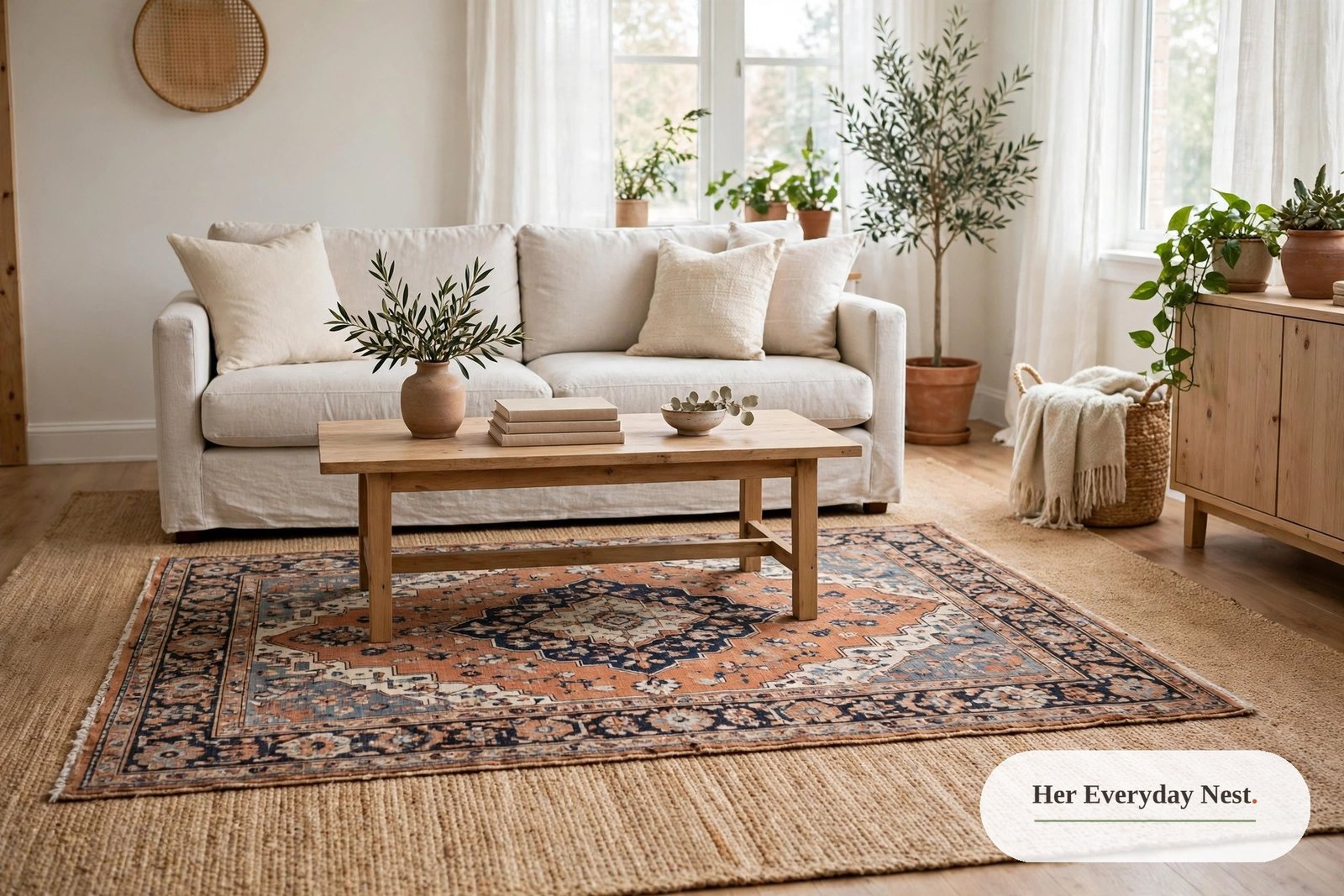
Layering is the renter’s best rug trick, and the formula is simple: a large plain base rug, with a smaller patterned rug on top covering about two-thirds of it. The base does the real job — it anchors the furniture and covers the floor — while the top rug brings the colour and pattern. A jute or flatweave base in a natural tone, with a vintage-style patterned rug on top, reads as collected rather than coordinated, which is exactly the look that makes a rental feel like a home.
Get the sizes right and the rest is taste: on an 8×10 base, the top rug wants to be about 2 feet narrower and 2 feet shorter — a 6×8, for example — so 12 to 24 inches of base shows around it on every side. Share at least one colour between the two rugs so they feel related, and contrast the textures: rough natural fibre underneath, softer wool or cotton on top. A rug pad under the base layer stops both rugs from sliding. For the sizing math behind every common pairing, DreamyHomeStyle’s guide to layering rugs works through the numbers for five standard base-and-top combinations. Best for living rooms with floors you do not love, and for anyone who already owns a rug that does not quite fit the new place.

3. Put a Washable Rug Where Life Actually Happens
In a rental, a stained rug is not just ugly — it is a security deposit problem. That is why washable rugs belong exactly where life happens: under the coffee table, beside the bed, in the dining area, and anywhere muddy paws, red wine, or a toddler’s juice box might land. A machine-washable rug folds down small, goes through a standard wash, and comes back looking new, which no professional-cleaning-only rug ever will.
Look for low-pile, water-repellent construction: spills bead up on the surface instead of soaking in, and the thin profile clears door gaps and does not catch a robot vacuum’s wheels or a rolling desk chair. Keep one washable rug per high-traffic zone and save the plush, hand-knotted pieces for low-traffic corners. For a clear-eyed rundown of which washable and grip-first rugs actually hold up in small rentals, NestSorted’s small apartment rug ideas build the whole list around grip and washability first, style second. Best for homes with kids or pets, entryways, and anyone who has ever panicked over a spilled glass of wine.

4. Anchor Every Rug With a Non-Slip Pad
A rug that slides is a hazard no matter how nice it looks — and in a rental, it is also a floor-damage risk. A non-slip rug pad is the cheapest insurance on this list: a few dollars, cut to size, placed under the rug, and the rug stays put through vacuuming, kids, pets, and everyday foot traffic. It also protects the original floor underneath from scratches and adds a little cushion underfoot.
Choose the pad for the floor, not the rug: a felt-and-rubber pad grips hardwood and laminate, while a rubber-mesh pad works on tile. Avoid cheap rubber-backed pads that can transfer colour onto light floors — a quality pad is the one place not to save a few dollars. Reusable dual-sided gripper pads are another renter-safe option, since they use no adhesive and leave no residue at all. Best for hardwood and tile floors, homes with kids or dogs, and every rug that has ever crept out from under the sofa.

5. Layer a Rug Over Wall-to-Wall Carpet You Did Not Choose
Most rentals come with wall-to-wall carpet in a colour nobody would pick — beige, grey, or worse, stained. A rug on top of carpet is the fix, and it works better than most renters expect. A large, low-profile rug breaks up the monotony, hides wear and tear, and gives you a blank slate to express your style, all without touching the floor underneath.
Keep the top rug low-pile so it does not bunch, and use a non-slip pad or carpet tape underneath to stop it sliding on the softer surface. A bold pattern draws the eye away from any stain underneath, while a large neutral rug simply covers the problem area entirely. The same trick works over damaged laminate or scuffed tile: cover the worst patch, not the whole room. Best for rentals with stained or dated carpet, and for anyone whose lease forbids changing the flooring.

6. Zone a Studio With Rugs Instead of Walls
In a studio or open-plan rental, a rug is the closest thing to a wall you are allowed to build. One rug anchors the living area, another defines the sleeping corner, and a third marks the work-from-home station — and suddenly a single open room reads as three distinct spaces. It is one of the most useful renter friendly rug ideas for small apartments, because the zoning is visual, not structural, and it moves with you.
Give each zone its own rug and its own colour story, but keep one shared tone across all three so the apartment still feels like one home. A large rug under the sofa and chairs marks the lounge; a smaller, softer rug beside the bed marks the bedroom; a low-pile rug under the desk keeps the chair from catching on a hard floor edge. If your work corner needs a full setup plan, our renter-friendly home office ideas show how to carve out a desk zone in a studio without blocking light. Best for studios, open-plan apartments, and anyone whose living room, bedroom, and office share one floor.

7. Run a Runner Down the Hallway
Hallways are the most wasted space in a rental, and a runner is the cheapest way to make one feel considered. A long, narrow rug elongates the space, softens footsteps, and turns a plain passage into a deliberate part of the home. It also protects the floor in the highest-traffic strip of the apartment — the path everyone walks a dozen times a day.
Choose a washable, low-pile runner with a non-slip backing, about 2’6″ wide, and leave a few inches of bare floor showing on each side so the hallway reads wider, not narrower. A runner in the kitchen works the same way: a washable strip in front of the sink and stove adds comfort while you cook and catches the drips that would otherwise mark the floor. Best for long hallways, galley kitchens, and entryways that currently feel like an afterthought.

8. Give the Bedroom a Soft Landing
The first step out of bed in the morning should land on something soft, not cold tile or hard wood. Lay a rug under the lower two-thirds of the bed, with 50 to 60 cm of rug showing on each side and at the foot, so your feet find warmth whichever side you get out on. It is a small change that makes the whole bedroom feel softer, quieter, and more finished.
Size it by the bed: a queen bed wants roughly an 8×10 rug, a king a 9×12, and a twin a 5×7 placed along one side. A plush, high-pile rug feels luxurious here because nobody rolls a chair across it — save the low-pile workhorses for the living room and office. For the bedding layers and lighting that complete the room around it, our renter-friendly bedroom ideas cover the full bedroom plan. Best for bedrooms with hard floors, cold mornings, and anyone who wants the room to feel like a retreat.

9. Choose Low-Pile Under the Dining Table
Under a dining table, pile height is everything. A high-pile rug traps crumbs, catches chair legs, and turns every meal into a vacuuming job. A low-pile or flatweave rug lets chairs slide easily, wipes clean with a damp cloth, and still defines the dining zone beautifully — especially in an open-plan apartment where the table would otherwise float in the middle of the room.
Size it generously: the rug should extend at least 24 inches beyond the table on every side, so chairs stay on the rug even when pulled out. A washable flatweave is the safest pick here, and a darker pattern hides the inevitable spaghetti sauce. Keep the rug’s edges clear of walkways so nobody trips on the transition. Best for open-plan dining areas, homes with kids, and anyone who eats at the table every day.

10. Use a Round Rug in an Awkward Corner
Some corners refuse to behave: a bay window, a reading nook, a round side table, or a spot where a rectangular rug would always look slightly wrong. A round rug solves all of them. Its soft shape breaks up the straight lines of an apartment, makes a small nook feel intentional, and needs no precise measuring — a 4-foot round rug fits almost any corner that a rectangular rug would fight.
Place one under a round coffee table, in a bay window with a chair and a lamp, or at the foot of a bed where a rectangle would crowd the walkway. A hand-braided jute round adds texture without pattern, while a small patterned round becomes a jewel box in an otherwise plain room. Best for bay windows, reading nooks, small bedrooms, and any corner that has resisted every rectangular rug you have tried.

11. Warm Up the Kitchen With a Washable Runner
Rental kitchens are usually the coldest, hardest room in the apartment — tile underfoot, nothing soft anywhere. A washable runner in front of the sink and stove changes that in minutes: it cushions your feet while you cook, catches drips before they mark the floor, and adds the only colour the room may ever get. It is one of the cheapest renter friendly rug ideas on this list, and one of the most lived-with.
Pick a low-profile runner that clears the door swing and does not catch a stool or a step ladder, with a non-slip backing so it cannot slide on wet tile. A 2’6″ × 6′ or 2’6″ × 8′ runner suits most galley kitchens; in a larger kitchen, two short runners — one at the sink, one at the stove — work better than one long one. Toss it in the wash weekly and it stays fresh. Best for galley kitchens, tile floors, and anyone who stands at the sink every day.

12. Protect the Floors — and Your Deposit — With the Right Backing
A rug protects the floor underneath it, but only if the backing is right. The wrong backing can do real damage: cheap rubber can transfer colour onto light hardwood, and a rug with no pad at all lets grit grind into the finish every time someone walks across it. A quality felt-and-rubber pad under every rug is deposit insurance that costs a few dollars and takes five minutes to install.
Check under your rugs once a season: lift a corner, vacuum the floor beneath, and air the rug out so moisture never builds up underneath — dampness is what causes the musty smell and the dark patches landlords notice at move-out. If a rug has a rubber backing, test it on a hidden spot first, and never use a self-adhesive floor sticker anywhere: glue residue is the one rug-adjacent mistake that actually costs deposit money. Best for hardwood and laminate floors, humid climates, and anyone who wants their full deposit back.

13. Let a Rug Carry the Colour the Walls Can’t
In a rental you cannot paint, the rug is your biggest canvas. A bold Moroccan pattern, a vintage Persian, or a bright geometric rug brings the colour and personality that white walls never will — and it does it on the floor, where it is allowed. One strong rug can set the whole room’s palette: pull one colour from it for the cushions, another for a throw, and the room ties together without a single wall change.
Keep the rest of the room calm when the rug is loud: neutral sofa, plain curtains, one or two accent colours repeated, and the rug stays the star instead of competing with everything else. If the rug is subtle, flip the rule — let the cushions and art bring the colour. Either way, the rug is doing the decorating work the walls cannot. Best for white-box rentals, neutral furniture, and anyone whose lease says no painting.

14. Try a Vintage Rug on Top for Instant Character
A worn vintage rug layered on top of a plain base is the fastest way to make a rental look collected instead of decorated. The faded colours, the fringe, the slight unevenness — all of it reads as history, and it hides spills and wear far better than a perfect new rug ever will. You do not panic when someone drops a glass of red wine on a rug that has already survived fifty years.
Look for genuine vintage or vintage-style pieces in the size your layering formula needs — usually a 5×7 or 6×9 on top of an 8×10 or 9×12 base — and check the pile is low and even enough to vacuum easily. A vintage top layer pairs best with a plain natural-fibre base, so the pattern has room to breathe. Best for living rooms that feel too new, pattern lovers, and anyone who wants character without committing to a bold permanent choice.

15. Roll It Up and Take It With You
Here is the part no other decor decision offers: when the lease ends, the rug leaves with you. A good rug is not a sunk cost in someone else’s apartment — it is an investment in every home you will ever live in. Buy for the room you have, but buy a size and style that will work in the next place too: a neutral 8×10, a classic pattern, a washable runner — all of them move, all of them adapt.
That portability changes how you should shop. Spend a little more on the one big rug you will keep for years, and spend less on the trendy top layers you may swap next season. Roll rugs for moving, never fold them — folding creases the backing and the crease can take months to relax. Store them upright, wrapped, and dry, and they will be ready for the next apartment on day one. Best for everyone, and the cheapest idea on this list: it costs nothing, and it is the whole point of renter friendly rug ideas.

Conclusion
A small rental does not need new floors to feel like home — it needs better rugs. Start with the one move that changes everything: a single rug big enough for the front legs of all your seating. Then add the layer that makes it feel designed, whether that is a patterned rug over a jute base, a washable runner in the hallway, or a soft rug beside the bed. Finish with a non-slip pad underneath and a little colour on top, and the apartment feels finished.
The best part of these renter friendly rug ideas is that every single one of them leaves with you. Nothing is glued down, nothing needs patching, and nothing will cost you a cent of your deposit. Pick the idea that fits your room, your budget, and your lease, set it up in an afternoon, and enjoy a rental that finally feels warm, zoned, and like home.
Can I put a rug over carpet in a rental?
Yes. Layering a rug over wall-to-wall carpet is a common renter trick. Choose a low-profile rug so it does not bunch, and use a non-slip pad or carpet tape underneath to stop it sliding on the softer surface. A bold pattern hides stains and wear in the carpet below, while a large neutral rug simply covers the problem area. Just vacuum between the layers every few weeks, since dust collects under the top rug faster than you would expect.
How big should a rug be in a small apartment living room?
Big enough for the front legs of all your main seating to sit on it — for most living rooms that means an 8×10 rug, and a 9×12 for a larger seating group. The rug should run about 6 inches past each end of the sofa and leave roughly 12 to 18 inches of bare floor between the rug and the walls (12 inches in a small room). A rug that is too small is the most common mistake in small apartments, and it makes the room look smaller, not bigger.
How do I keep a rug from sliding on hardwood floors?
Use a quality non-slip rug pad cut to the rug’s size — felt-and-rubber pads grip hardwood and laminate best, and they also protect the original floor from scratches. Reusable dual-sided gripper pads are another renter-safe option since they use no adhesive and leave no residue. Avoid cheap rubber-backed pads, which can transfer colour onto light floors. If the rug still creeps, check that the pad is the right size: a pad smaller than the rug lets the edges slide.
Are washable rugs worth it for renters?
Yes, especially in high-traffic zones. A washable rug goes through a standard washing machine, so a spilled glass of wine or a muddy paw print is a laundry problem, not a deposit problem. Look for low-pile, water-repellent construction so spills bead up instead of soaking in, and a thin profile that clears door gaps and does not catch a robot vacuum. Keep washable rugs where life happens and save plush, hand-knotted pieces for low-traffic corners.
How do I layer rugs without it looking messy?
Follow the formula: a large plain base rug that could work alone, with a smaller patterned rug on top covering about two-thirds of it — on an 8×10 base, the top rug should be about 2 feet narrower and 2 feet shorter, so 12 to 24 inches of base shows on every side. Share at least one colour between the two rugs, contrast the textures (rough natural fibre below, softer wool or cotton on top), and put a rug pad under the base layer so nothing slides. Vacuum between the layers weekly.

Emily Carter is the founder and editor of Her Everyday Nest. After nine years of renting in five apartments across three cities, she's learned how to make any rental feel like home.